Start with measurable visibility goals
When teams begin optimizing for generative search, they often start with vague targets like “get more mentions.” A practical plan starts by defining what visibility means for your business and how you will measure it. For most brands, AI visibility includes being AI Visibility Platform mentioned and being cited as a source when users ask questions related to your products, categories, or expertise. Without those definitions, it’s difficult to tell whether your efforts are improving discovery or just generating noise.
Map your goals to specific AI experiences where users encounter answers. For example, ChatGPT responses, Google AI Overviews, Gemini summaries, Perplexity citations, and Claude-style explanations all behave differently and may cite sources using different patterns. Decide which channels matter most for your audience and set targets such as “increase citations in product comparisons” or “grow mentions for industry FAQs.” Then establish baseline measurements so you can evaluate progress after you make content and outreach changes.
Audit your current content and citation readiness
Before you chase new placements, evaluate whether your existing assets are discoverable and reference-friendly. Many brands publish content that is useful to humans but hard for AI systems to interpret and cite, especially when key claims are buried in long pages, missing context, or lacking structured explanations. Perform a content audit focused on the queries your customers ask and the knowledge your sales and support teams repeat. Look for gaps in coverage, outdated explanations, and pages that do not clearly define the problem, solution, and supporting proof.
Next, check citation readiness by ensuring your most important pages communicate verifiable information. Add clear headings, factual statements, and specific examples that answer common follow-up questions. Where appropriate, include data sources, author expertise, and concise summaries that can be extracted without losing meaning. If you have multiple pages competing for the same topic, consolidate or differentiate them so AI systems can identify the most authoritative version of the information.
Run a repeatable measurement workflow
A practical measurement workflow turns AI visibility from a guess into a system. Begin by selecting a set of brand and product prompts that represent how people search in conversational formats. Include variations of your brand name, product lines, and common industry terms, because AI systems often treat phrasing differences as separate retrieval events. Track both mentions and citations, since mentions indicate exposure while citations indicate credibility and usefulness within answers.
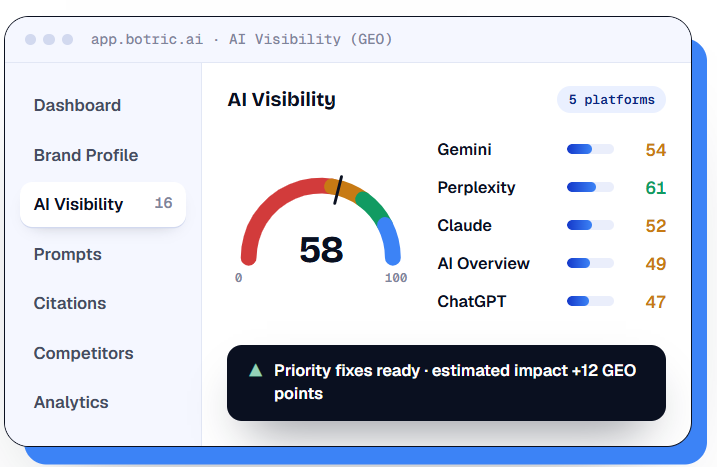
Use a tool that monitors AI brand visibility across multiple models so you can compare performance consistently. Botric is designed to measure how often major AI assistants mention and cite your brand, making it easier to see where your authority is strengthening. Build a cadence for reviewing results, such as weekly checks for trend direction and monthly reviews for deeper analysis. When a visibility spike appears, investigate which prompts triggered it and which pages or sources were referenced, then replicate what worked.
Optimize for prompts, sources, and authority signals
Once you understand your baseline, prioritize optimization tactics that improve how AI systems decide which sources to use. Start by aligning content with intent clusters like “how to choose,” “best practices,” “compare options,” and “troubleshooting.” Then rewrite key sections to answer the full question, not just the first part, using concise definitions, step-by-step guidance, and clear boundaries about when your approach applies. This helps AI systems extract coherent snippets that fit naturally into an answer and increases the likelihood of being cited.
Strengthen authority signals by improving transparency and expertise signals that AI systems can rely on. Publish author bios with relevant credentials, maintain consistent terminology across your site, and ensure your references are accurate and up to date. Where you support claims with research, link to original studies and explain how the findings relate to your product or service outcomes. Finally, coordinate distribution: use community participation, partnerships, and targeted outreach so reputable sources can point back to your best reference pages.
Conclusion
An effective AI visibility plan is built on clear goals, citation-ready content, and a repeatable measurement workflow. Instead of treating generative search as a black box, define what success looks like in terms of mentions and citations across major AI assistants. Then audit your current assets to ensure they communicate verifiable, extractable information that supports trustworthy answers. From there, optimize based on prompt patterns and the sources that AI systems prefer. Use consistent tracking to identify what increases both exposure and credibility, then scale the changes that produce the strongest outcomes. With a structured approach like the one supported by Botric, you can move from sporadic content efforts to a durable AI visibility strategy.